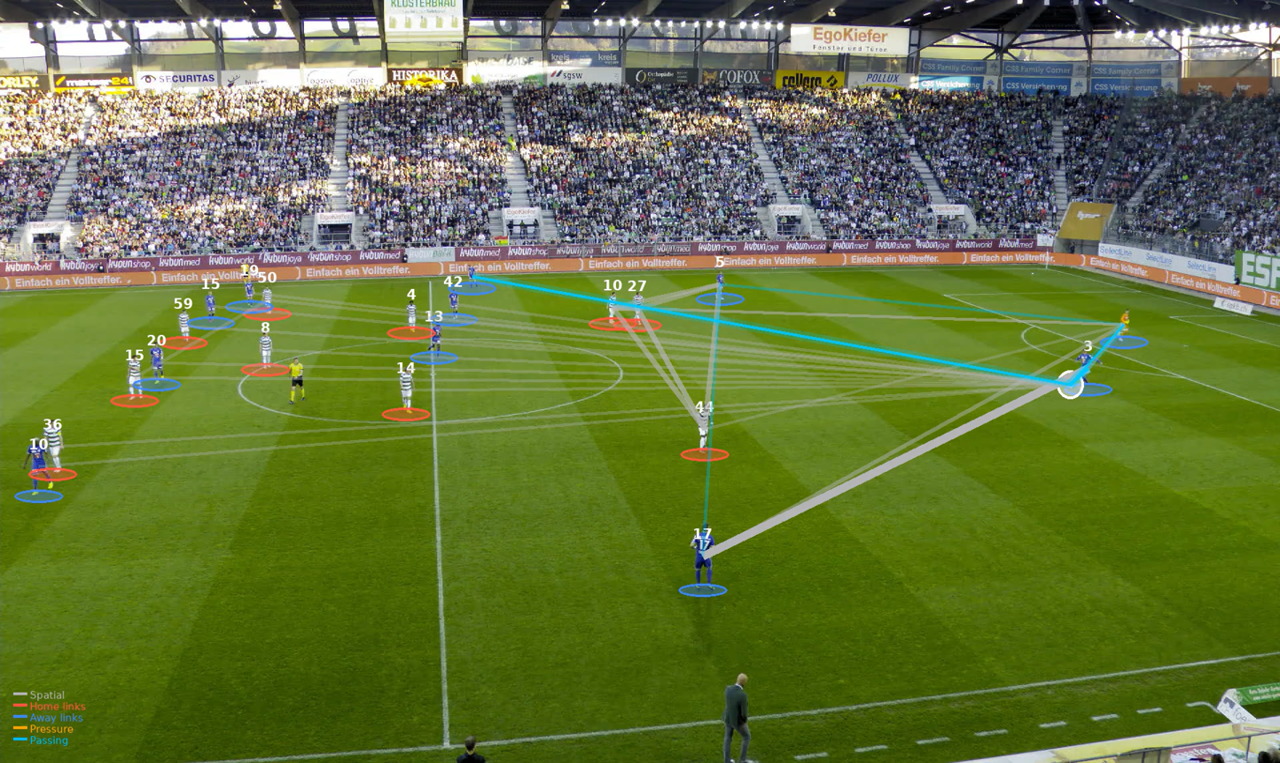
While watching the World Cup 2026, something stayed with me.
Modern football broadcasts are full of technology: high-resolution cameras, player tracking, 3D reconstruction, real-time statistics, expert commentary… They created a lot of data.
Wondering how these data actually helps the coaches on tactics? I don’t think football analysts are overwhelmed by pixels. They see something else: a defensive block gradually losing compactness, a pressing trigger, a passing lane opening…
The tracking system saw 22 moving coordinates. The coach saw a defensive block beginning to collapse. Pressure, compactness, passing lanes. Both were looking at exactly the same match.
Same thing happens in Engineering.
A crash simulation returns millions of nodal displacements, CFD simulation returns millions of pressure values. Yet engineers rarely reason directly from those numbers. They immediately think in load paths, mode shapes, wake structures…
The Missing Interface
💡 Experts do not reason directly from measurements. They reason through abstractions.
An abstraction is how experts think. A representation is how machines access that abstraction.
Abstraction is the philosophy. Representation is the implementation.
Models come later.
The same pattern kept reappearing across projects. Every mature engineering discipline converges on its own abstractions. Control reasons through state-space. Structural engineering through mode shapes and load paths. Aerodynamics through wake structures and flow separation. Autonomous driving through scenarios.
These weren’t just domain conventions. They shared one important property: they preserved engineering meaning even when geometry, sensing, or application domain changed. The mode shape transfers across vehicle platforms, the mesh does not. The wake structure remains the vocabulary across design iterations, the cell count does not.
I started calling them Canonical Engineering Representations.
The mode shape is an abstraction. The graph that encodes it is its engineering representations. Football coordinates are no different. Twenty-two numbers per frame are not the representation. The pressure, the compactness, the passing lane are, and the graph that encodes their relationships is the reprentation.
The representation should match the expert’s abstraction before the model starts learning. Otherwise, AI learns to predict measurements. Not to collaborate with experts. The goal is not simply to make AI more accurate. It is to make AI reason in a form that experts can immediately understand, critique, refine, and ultimately trust.
Engineering AI should not begin by asking what models engineers need. It should begin by asking how engineers already understand the world.
         Domains
            │
            ▼
           Data
(pixels · point clouds · coordinates)
            │
            ▼
  Engineering Abstractions
(load paths · wake interaction · mode shapes · dominance regions)
            │
            ▼
  Canonical Engineering Representations
      (graphs · fields · meshes)
            │
            ▼
   Engineering Tokens
(structured atomic units of engineering meaning — future)
            │
            ▼
Engineering Foundation Models
(models that reason across engineering domains — future)
Engineering meaning lives in the abstraction. Engineering intelligence begins with its representation. Everything above is raw data. Everything below is inference.
AI Model Is No Longer the Bottleneck
Across domains, one structure keeps emerging in how experts reason: relationships, interactions, dependencies between elements, not isolated measurements. The abstraction is relational. Which architecture models it is, increasingly, a secondary concern. And the architecture options have never been richer.
Graph neural networks make relationships explicit by construction. Transformers, originally for language, have proven remarkably capable of modeling structured relationships across vision, simulation, and physical systems, from protein folding to fluid dynamics. Geometric deep learning encodes symmetry and physical invariance directly into the architecture. Modern foundation models, trained across modalities and domains, are beginning to show that relational structure can be learned, transferred, and generalized at a scale that was unimaginable before.
The bottleneck is not the AI architecture. It is the abstraction and representation of engineering knowledge.
Why Football ⚽?
Because I like the sport and play, watch the WC2026 often :). And I’m curious could the same abstraction survive outside engineering entirely?
Football looked like a very interesting experiment. It is geometrically simpler than automotive CAE. The field is flat. The geometry is fixed. There are always 22 players + 1 ball. Yet the dynamics are richer. Every player anticipates, adapts, deceives, reacts.
The complexity is not geometric. It is relational.
That made football the right validation problem for relational complexity. I spent several nights building the first version to find out.
That experiment became TacticalGraph, a test of whether a representation built around the coach’s abstraction, not the tracking system’s measurements, could survive a completely different domain.
The prototype is intentionally compact: a single model with 61,872 parameters — deliberately small, roughly the size of a basic image classifier — trained on three public tracking datasets (SoccerNet-GSR, Metrica, and SoccerTrack v2), producing 9 simultaneous tactical predictions from player positions alone. Each player is a node with coordinates, and the edges connect the players. Together, they create formation and tactics.
Three of those predictions are already validated:
| Prediction | Question | AUC |
|---|---|---|
| Dangerous Attack | Does this team shape create a threat within the next 10 seconds? | 0.953 |
| Pressing Trigger | Is the defending team about to collectively close down the opponent? | 0.904 |
| Possession Transition | Will the ball switch sides in the next 5 seconds? | 0.856 |
These are not simple pattern matches. They are tactical concepts that coaches and analysts spend years learning to read. The model learned them from geometry and movement alone, no manual annotation, no event tagging, no human labeling beyond raw tracking coordinates. And it can scale very well with more data.
Engineering Knowledge as Supervision
The second insight came during training. Football has enormous tracking data and almost no tactical annotations. So instead of asking analysts to label thousands of situations, football knowledge itself became the supervision signal. Danger defined as future ball progression. Pressing defined from collective player geometry. Transitions defined from possession changes.
This is closer to what researchers call programmatic or weak supervision: human knowledge encoded as labeling objectives rather than individual annotations or self-supervised learning in the strict sense. The labels come from the data.
This is not a universal principle. Labeling approaches vary significantly across domains. But the question is worth asking: does a given domain have enough internal structure to supervise its own learning. And if so, is that structure being used?
The challenge is not always collecting more data. Sometimes it is recognizing what the domain already knows and encoding that as supervision.
Engineering Tokens and What’s Next
Large language models (LLMs) do not begin with raw characters. They begin with a structured vocabulary that allows knowledge to be represented, reused, and composed. The intelligence of the model comes not only from its architecture, but from learning over a shared representation of language that has evolved over centuries.
Engineering already possesses an equally rich vocabulary (load paths, mode shapes, pressure…). These are not labels added after the analysis. They are the abstractions engineers naturally use to understand physical systems. They encode decades of accumulated engineering knowledge and compress enormous amounts of physical complexity into concepts that experts immediately recognize.
That led me to a simple question: What if AI could reason directly using those engineering concepts?
That is what I mean by Engineering Tokens.
Not a new neural network. Not a new dataset. A different answer to a more fundamental question:
What should an Engineering AI system think in and explain?
Not raw measurements, pixels, meshes, or sensor streams. But reusable representation of the same engineering abstractions that experts already use to reason.
If a model learns in that representation, its conclusions become easier to interpret — not only because we explain them afterward, but also because the reasoning is already expressed in concepts engineers understand.
This is the direction I will to explore next.
Conclusion
Enjoy the World Cup 2026. And if you find yourself watching a match and thinking about load paths and mode shapes — welcome to my world :) .
And perhaps next time, instead of starting with AI models, we begin by building AI that adapts to engineering knowledge.
If this connects with something you are working on, I would be glad to hear about it.